



Your Search Console Impressions Are Up But Clicks Are Down – Here’s What’s Actually Happening (Phoenix Business Guide, 2026)
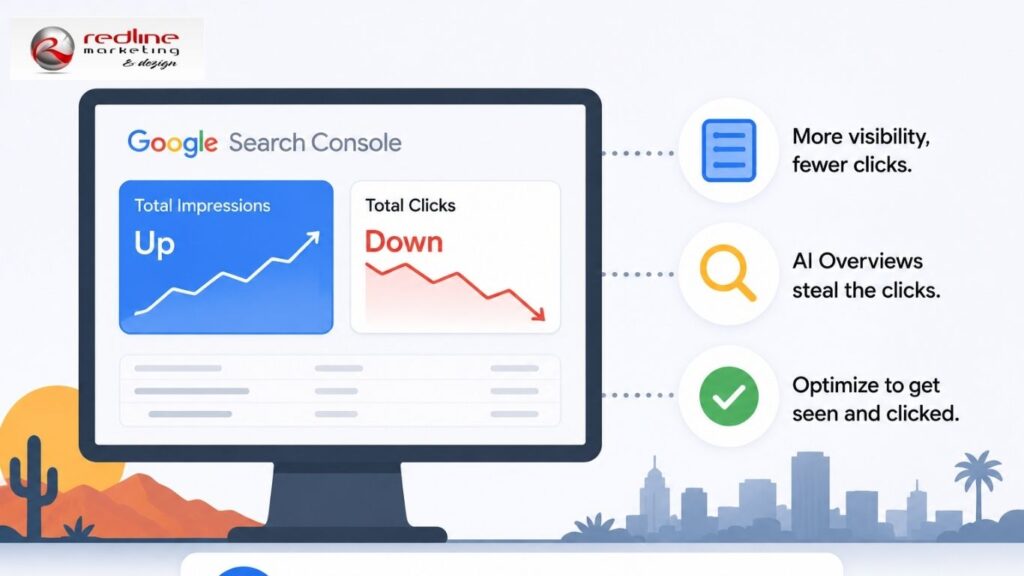
If you’ve checked Google Search Console lately and noticed something strange, impressions climbing, clicks flatlining or dropping, you’re not imagining it, and you’re not alone. This is happening to businesses across Phoenix and across the country right now, and it has a name inside the SEO industry: the Great Decoupling.
Here’s what’s really going on, and what your business needs to do about it in 2026.
Why Your Clicks Are Disappearing Even Though You’re Ranking
Google’s AI Overviews, the AI-generated summary box that now appears above traditional search results, have fundamentally changed how people search. As of early 2026, AI Overviews show up on roughly 48% of all Google search queries, a 58% increase year over year. For informational and “how does this work” style searches, that number climbs even higher.
The effect on clicks has been steep. Pew Research found an average 46.7% relative decline in click rates when an AI Overview appears, based on 68,000 real search queries. Ahrefs’ research told a similar story: a 58% CTR reduction on the top-ranking page for keywords that trigger an AI Overview. Put simply, ranking #1 doesn’t guarantee a visit anymore, Google may just answer the question itself before anyone reaches your site.
This is why your Search Console impressions can rise (Google still logs an AI Overview as an impression) while your actual clicks fall. Roughly 60% of Google searches now end without a single click to any website, and for queries where an AI Overview appears specifically, that zero-click rate jumps to 80 to 83%.
The Upside Nobody Talks About
Here’s the part that matters most for your business: visibility inside the AI Overview itself is now a real growth channel, even without a click. Brands cited in AI Overviews earn approximately 120% more organic clicks per impression than uncited brands on the exact same queries. Seer Interactive’s research backs this up too, brands cited inside the AI Overview get 35% more organic clicks and 91% more paid clicks than brands that aren’t cited on the same results page.
In other words: being invisible to AI search is now costing Phoenix businesses real leads. Being cited, even without the click, builds trust and drives people to search your brand name directly, which is a much stronger buying signal anyway.
Why This Matters More for Small and Local Businesses
Not every industry is hit equally. B2B and technology-style queries see AI Overview exposure rates around 70%, while transactional and e-commerce queries see them far less often, around 4%. That’s actually good news for local service businesses: if your website is built to answer real customer questions clearly (not just list services), you have a genuine shot at being the source Google and AI tools pull from, while your competitors, who built a website years ago and never touched it again, get skipped entirely. At Redline Marketing and Dezign, this is exactly why we focus on structured, question-driven content that performs in both Google and AI-powered search systems.
What Actually Works Right Now
- Structure content to answer questions directly. AI Overviews and AI search tools reward clear, direct answers over vague marketing copy. The system favors pages that clearly answer questions, define concepts, and explain processes in a structured way, this is why pages ranking outside the top 10 still get referenced in AI summaries.
- Add FAQs, schema markup, and clean headers to every page. This is exactly what helps a page get picked up as a citation source, not just a ranked link.
- Don’t measure success by clicks alone. Track brand searches, phone calls, and form fills alongside Search Console data, these are the metrics that actually reflect AI-era visibility.
- Rebuild pages that were designed only for old-school SEO. If your site is still built around keyword stuffing instead of real structure, mobile usability, and fast load times, you’re losing on both Google rankings and AI citations at once.
This is precisely where web design and SEO strategy have to work together, a site that looks good but isn’t structured for search intent won’t get cited by ChatGPT, Gemini, or Perplexity, no matter how nice it looks.
How Redline Marketing and Dezign Approaches This
| Element | Description |
| Approach | SEO + AEO-focused web design |
| Focus | Structured layouts, mobile-first performance |
| Strategy | Keyword alignment + internal linking |
| Goal | Visibility in Google + AI tools |
| Signal | “Impressions up, clicks down” indicates structural issues |
Conclusion
The shift toward AI-powered search isn’t a temporary trend, it’s a permanent change in how Phoenix customers find local businesses. The businesses that adapt their website structure and content strategy now will keep capturing visibility and leads. The ones that don’t will keep watching impressions climb in the Search Console while their phone stays quiet. If your website hasn’t been evaluated for this shift yet, now’s the time. Learn how to fix the real issues holding your website back from converting traffic into customers.
FAQ
Why are my Google impressions rising but my clicks falling?
Google counts AI Overview views as impressions, even without clicks, causing higher impressions but lower click-through rates despite stable rankings.
Does this mean SEO doesn’t matter anymore?
SEO still matters, but it has evolved. Success now depends on ranking plus being cited in AI Overviews, ChatGPT, Gemini, and other generative search systems.
How do I know if AI Overviews are affecting my website specifically?
Check Google Search Console trends. If impressions rise while clicks stay flat or drop, it strongly indicates AI Overviews are reducing click-through traffic.
Can a website redesign actually help with AI search visibility?
Yes. Clean structure, fast speed, clear headings, FAQs, and mobile optimization improve chances of being understood and cited by AI systems and search engines.
Should I focus on Google or AI tools like ChatGPT and Gemini?
Focus on both. Google and AI tools rely on similar signals like clarity, structure, authority, and usability, so optimizing for one benefits the other.
