



Google Ads in 2026: How AI Overviews Are Changing PPC for Phoenix Businesses (And What To Do About It)
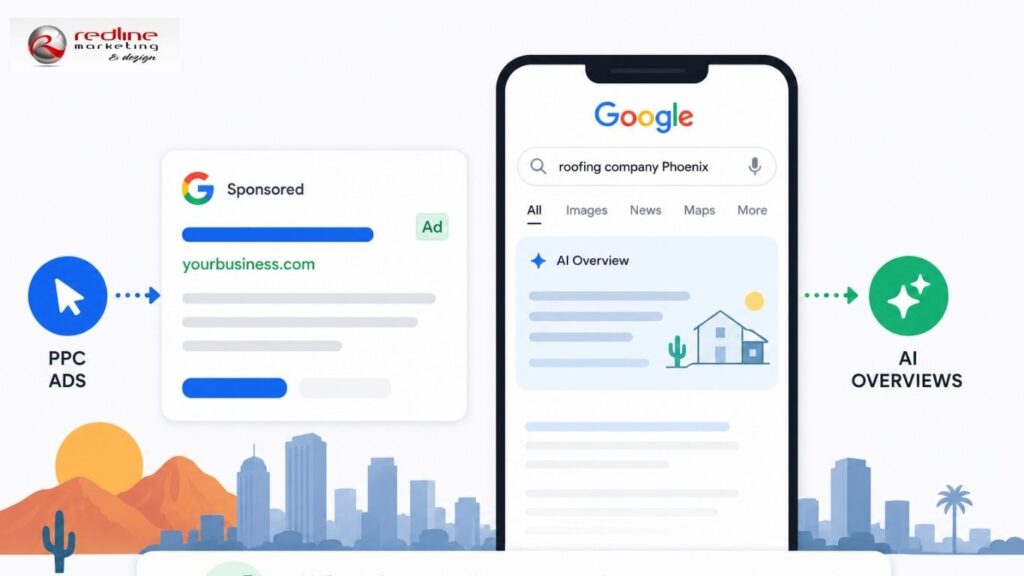
If you run Google Ads for a business in Phoenix, you’ve probably noticed something feels different this year. Clicks cost more. Some campaigns behave in ways you didn’t expect. And search results themselves look different, with AI-written summaries sitting above the ads and organic listings you’re used to competing for.
That’s not your imagination. 2026 is turning out to be one of the biggest shift years for paid search since Google Ads existed, and it’s happening because of two things colliding at once: AI Overviews taking over the search results page, and Google pushing nearly every advertiser toward AI-managed campaigns like Performance Max and AI Max.
For Phoenix business owners, this isn’t just an industry trend to read about. It directly affects how many calls, form fills, and walk-ins you get from Google every month. Here’s what’s actually happening, and what to do about it.
Why Search Results Look Different Right Now
Google’s AI Overviews now answer a large share of search queries directly at the top of the page, before a user even scrolls to organic listings or ads. Industry analysts estimate that a significant and growing portion of searches are becoming “zero-click,” meaning the user gets their answer without visiting any website at all.
At the same time, Google has been placing ads directly inside these AI-generated experiences rather than only below them. That means the old approach of writing a short, punchy ad and hoping it stands out on a crowded results page is no longer enough. Ads now need to feel like a natural, helpful part of the answer the AI is already giving the searcher.
For a Phoenix business, this means visibility isn’t just about bidding higher. It’s about being the kind of business Google’s AI trusts enough to reference and recommend in the first place.
Costs Are Rising, and Automation Is No Longer Optional
Search advertising costs have climbed sharply over the past two years, and 2026 has continued that trend, with average search cost-per-click reaching some of the highest levels since 2021. There are a few reasons behind it:
- More small and mid-size businesses are entering the auction now that AI tools have made campaign setup easier
- AI Overviews are pulling clicks away from organic listings, which pushes more businesses toward paid ads to stay visible
- Competition for the same limited pool of high-intent searches keeps growing
On the automation side, AI-powered bidding strategies like Smart Bidding now manage the large majority of ad spend across the platform, and most advertisers are running at least one AI-driven campaign type. Manual bidding still has a place for brand terms or small test campaigns, but for most Phoenix businesses, trying to out-manually-manage the algorithm is a losing strategy. The businesses seeing the best returns are the ones feeding Google’s AI clean, accurate conversion data and letting it do what it’s genuinely good at, while a real strategist manages the framework around it: budgets, goals, landing pages, and negative keyword lists.
What This Means If You’re Running Ads in Phoenix
A higher cost-per-click doesn’t automatically mean a worse return, but it does mean the margin for error is smaller than it used to be. A few things matter more now than they did even a year ago:
Clean conversion tracking. If Google’s AI is making most of the bidding decisions, it can only be as good as the data you give it. Businesses with accurate, properly configured conversion tracking are seeing meaningfully better cost-per-conversion than those running on guesswork.
Stronger, more detailed landing pages. Short, splash-style landing pages that used to convert well are being challenged by a new expectation: pages need enough real content and context for Google’s AI to understand what you offer and consider referencing your business inside an AI Overview or AI Mode answer.
Local relevance and structure. Geo-targeted, intent-driven campaigns that clearly signal “this business serves Phoenix, AZ” continue to outperform generic, broad campaigns, especially as competition and costs increase across nearly every industry.
A verified, complete brand presence. Google’s newer brand profile features surface verified business information directly in search results. When AI summarizes what’s available to a searcher, a business with a complete, consistent, verified presence is simply more likely to get mentioned.
Where AI Search Visibility Fits In
Google is no longer the only place people search. ChatGPT, Gemini, and Perplexity are increasingly being used the way people once used a search bar, especially for research-heavy or local recommendation queries. These tools tend to pull from businesses that already have strong, consistent, well-structured information across the web, not just a homepage.
That’s a meaningful shift for Phoenix businesses to plan for. Showing up well in Google Ads and organic rankings is still essential, but it’s now only part of the picture. Being structured and findable in a way that AI systems can understand and reference is quickly becoming its own discipline, separate from traditional SEO or paid search.
What To Do Next
None of this means Google Ads has stopped working. It means the businesses that treat it as a managed, data-driven system, rather than something to set up once and leave alone, are the ones pulling ahead in 2026. That includes clean tracking, stronger content, tighter local targeting, and a brand presence that’s consistent everywhere Google, and now AI search tools, might look.
At Redline Marketing and Dezign, we build Google Ads campaigns for Phoenix businesses with exactly this shift in mind, paired with SEO and AEO work so your business shows up whether someone is searching on Google, asking an AI assistant, or scrolling an AI Overview. If your current campaigns feel like they’re working harder for less, it’s worth a second look.
Conclusion
Search is changing faster in 2026 than it has in years, and Phoenix businesses that keep running Google Ads the same way they did two years ago are likely paying more for weaker results. The businesses pulling ahead are the ones adapting: cleaning up their data, strengthening their content, and making sure they’re visible not just in Google’s paid results, but in the AI-driven search experiences that are becoming the new front door to the internet.
If you want a Google Ads strategy built for how people are actually searching right now, Redline Marketing and Dezign can help you build it.
Frequently Asked Questions
What are AI Overviews and how do they affect Google Ads?
AI Overviews are AI summaries at top of Google results. They reduce website clicks and shift visibility, sometimes placing ads within AI-generated answers.
Why has the cost of Google Ads gone up in 2026?
Costs increased due to higher competition, more advertisers, and AI Overviews reducing organic traffic, pushing more businesses into paid search auctions.
Should my business rely on AI-driven campaigns like Performance Max or AI Max?
Yes, partially. AI campaigns improve performance, but they still need human oversight for strategy, budgets, tracking, and keyword control.
How can a Phoenix business improve visibility in AI search tools like ChatGPT or Gemini?
Use AEO strategies: structured content, FAQs, schema markup, and strong authority signals across your website and trusted external platforms.
Is it still worth running Google Ads for a local Phoenix business in 2026?
Yes. It’s still effective for quick leads, but requires strong targeting, optimized landing pages, and proper conversion tracking.
How often should Google Ads campaigns be reviewed?
At least monthly. AI-driven ad systems change fast, so regular optimization is needed to control cost and improve results.
