



How to Get Found on Google AND AI Search in 2026: A Complete Guide for Small Business Owners
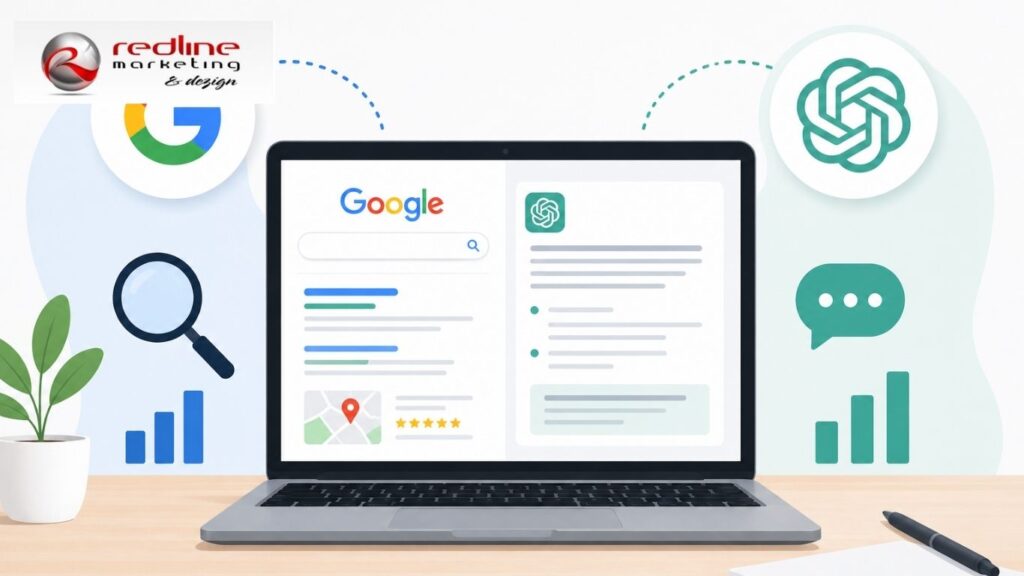
If you run a small business in the USA and you’re still only thinking about Google rankings, you’re already behind. In 2026, your customers aren’t just searching on Google, they’re asking ChatGPT, Gemini, Perplexity, and Google’s AI Overviews to recommend businesses like yours. If you’re invisible on those platforms, you’re handing revenue to your competitors every single day.
This guide breaks down exactly what it takes to dominate both traditional organic search and the new world of AI-powered search, and how to turn that visibility into real conversions.
Why “Just Doing SEO” Is No Longer Enough
Traditional SEO, keyword stuffing, building backlinks, optimizing title tags, still matters. But it’s only half the equation now. AI search engines don’t just crawl your site. They synthesize answers from multiple sources and recommend businesses based on authority, trust signals, and structured information.
Think about how your own behavior has changed. When you want a recommendation, you might type “best digital marketing agency near Phoenix” into Google, or you might ask Perplexity, “Who are the most trusted marketing agencies for small businesses in Arizona?” Both searches need to find you, and they use completely different signals to do it.
That’s the gap most small businesses are missing right now. And it’s also the biggest opportunity available to any business willing to act.
The Five Pillars of Visibility in 2026
1. On-Page SEO Built for Both Humans and AI Crawlers
Your homepage and service pages need to clearly answer the questions your customers are actually asking. That means using natural, conversational language, not just keywords. AI models like ChatGPT and Gemini pull answers from pages that are clear, well-structured, and authoritative.
Start by auditing your homepage. Does it immediately explain who you help, what problem you solve, and where you operate? Redline Marketing & Dezign’s homepage, for example, leads with “Digital Marketing Services That Actually Drive Local Sales”, that’s a clear, benefit-driven statement that tells both humans and AI crawlers exactly what the business does.
Use header tags (H1, H2, H3) to organize your content logically. AI models treat these like a table of contents, pulling relevant sections to answer user queries.
2. Google Business Profile Optimization
For local businesses, your Google Business Profile (GBP) is one of the single most powerful assets you own. It drives Google Maps rankings, powers local pack results, and increasingly feeds Google’s AI Overviews with business information.
Make sure your GBP has complete and accurate NAP data (Name, Address, Phone), updated business hours, high-quality photos, a detailed business description with your primary services, and a steady stream of fresh Google reviews. Businesses with 50+ reviews and an average rating above 4.5 stars appear significantly more often in AI-generated local recommendations.
3. Reputation Marketing as a Conversion Engine
Here’s a stat worth sitting with: 93% of consumers say online reviews impact their buying decisions. AI search platforms like Perplexity and Google’s AI Overviews actively factor in review volume, recency, and sentiment when deciding which businesses to recommend.
This means your reputation isn’t just a social proof tool, it’s an algorithmic ranking signal. Businesses that proactively request reviews after every job, respond to every review (positive and negative), and showcase testimonials on their website rank higher in both traditional and AI search.
Reputation marketing is one of the foundational strategies Redline Marketing & Dezign integrates into every client campaign, not as an add-on, but as a core growth driver.
4. Structured Data and Schema Markup
AI search engines love structure. Schema markup is a piece of code on your website that explicitly tells search engines and AI models what your business is, where it’s located, what services you offer, your hours, and your reviews.
Adding LocalBusiness schema, FAQ schema, and Service schema to your website dramatically increases your chances of appearing in AI Overviews, rich results, and voice search answers. Most small business websites don’t have this properly configured, which means implementing it is a genuine competitive advantage.
5. Content That Answers Real Questions
The businesses that win in AI search are the ones that consistently publish helpful, specific, question-answering content. Blog posts, FAQs, service pages, and case studies all feed the machine.
When someone asks ChatGPT “how do I get more leads for my landscaping business in Phoenix,” the AI is going to pull from pages that actually answer that question well. If your blog has a detailed, useful article on that topic, you become the source. That’s called Answer Engine Optimization (AEO), and it’s one of the fastest-growing services in digital marketing right now.
The Conversion Side: Turning Traffic Into Customers
Getting found is only half the battle. Once someone lands on your site, you have seconds to earn their trust and move them toward a conversion.
Here’s what the highest-converting small business websites do right:
- They lead with a clear value proposition above the fold, not a welcome message, but a benefit statement.
- They make the phone number and CTA button impossible to miss on mobile.
- They use social proof (reviews, logos, case study snippets) within the first scroll.
- They have a simple, friction-free contact form or booking tool.
- They load in under three seconds on mobile.
Redline Marketing & Dezign’s homepage already ticks most of these boxes, but every site has optimization opportunities, and even small improvements to conversion rate can dramatically reduce your cost per lead.
Conclusion
The digital marketing landscape in 2026 has split into two tracks: businesses that are visible on both traditional Google search and AI-powered platforms, and businesses that are slowly becoming invisible. There is no middle ground anymore.
The good news is that the same fundamentals that have always driven great marketing, clear messaging, trusted reputation, consistent content, and smart strategy, still apply. The difference is that the tools and platforms have expanded, and the businesses that adapt fastest will capture the most market share.
If you’re ready to stop guessing and start growing, Redline Marketing & Dezign offers a free, no-pressure strategy call where we audit your current digital presence and show you exactly what it would take to outrank your competitors, on Google, on Maps, and in AI search results.
Frequently Asked Questions
What is AEO and how is it different from SEO?
Answer Engine Optimization (AEO) focuses on getting your business recommended by AI-powered platforms like ChatGPT, Gemini, and Perplexity. Traditional SEO targets Google’s blue links. AEO targets the AI-generated answers that increasingly appear before those links, requiring structured content, schema markup, and authoritative brand signals.
How long does it take to rank in AI search results?
AI search visibility can improve within 30 to 60 days with the right content and technical changes. Google organic rankings typically take 60 to 90 days. Paid channels like Google Ads can drive results within days of launching.
Do small businesses in Phoenix really need AI search optimization?
Yes. Local search behavior is changing fast. A growing share of users now ask AI assistants for local business recommendations instead of browsing Google results pages. If your business isn’t optimized for these platforms, you’re missing an entirely new acquisition channel.
What is the most important first step to improve my online visibility?
Start with a full visibility audit, your Google rankings, Google Business Profile completeness, review volume and rating, website speed, and whether your site has schema markup. Redline Marketing & Dezign provides this as part of a free strategy call.
How do online reviews affect AI search recommendations?
AI platforms treat review volume, recency, and average rating as trust signals. Businesses with strong, consistent review profiles are recommended more often in AI-generated answers than those with few or outdated reviews.
