



How to Win Google Rankings, AI Search Visibility, and More Conversions
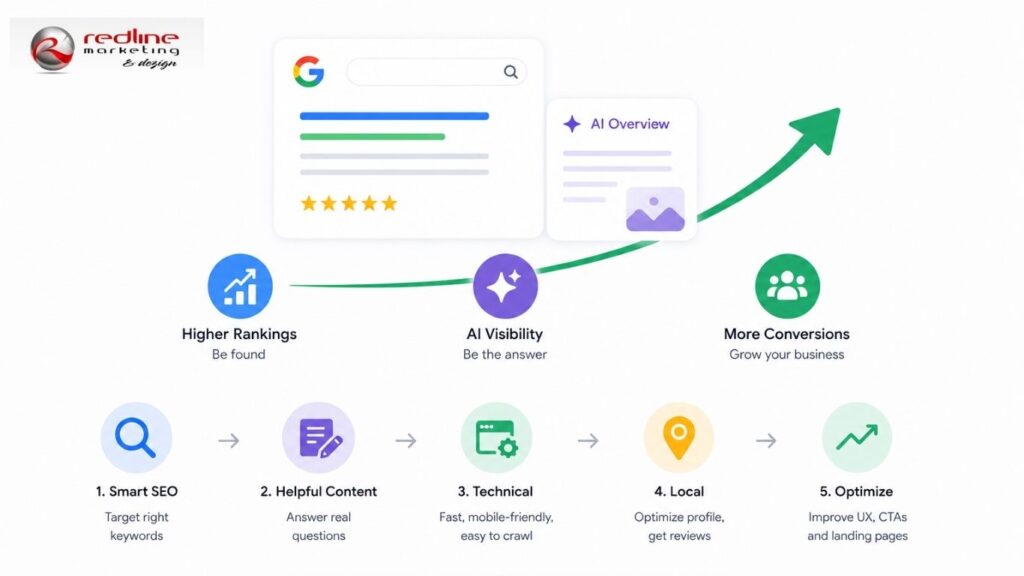
Search has split into two battlefields. On one side, you’re still fighting for a spot on Google’s first page. On the other, you’re competing to be the answer that ChatGPT, Gemini, Perplexity, and Google AI Overviews hand a user without them ever clicking through to a website. Businesses that only play the first game are quietly losing ground, because a majority of searches today end without a single click to any site.
That’s the reality Redline Marketing and Dezign built its strategy around. Winning today means doing three things at once: ranking organically on Google, becoming a source AI engines trust enough to cite, and turning that visibility into actual leads and sales. Here’s how those three pieces fit together, and how to approach each one.
1. Google Organic Rankings Still Matter, A Lot
Organic rankings remain the foundation everything else is built on. Even in an AI-first search world, Google is still the largest referral source for most local and service-based businesses, and ranking well brings compounding, low-cost traffic month after month.
A few fundamentals still drive this:
- Technical health – fast load times, mobile usability, clean site architecture, and no crawl errors holding your pages back.
- On-page relevance – content that actually answers the searcher’s intent, not just content stuffed with keywords.
- Authority signals – backlinks, citations, and a Google Business Profile that reinforces you’re a real, established business in your market.
- Content depth – pages that cover a topic thoroughly enough that Google trusts them as a complete resource, not a thin summary.
The businesses that keep climbing rankings treat SEO as ongoing maintenance, not a one-time project. Algorithms shift, competitors publish new content, and pages that go untouched for a year start losing ground even if nothing about them is technically wrong.
2. AI Search Visibility: The New Front Line
This is the part most businesses are still ignoring, and it’s costing them. AI platforms don’t rank ten blue links, they select one answer and present it directly to the user. If your business isn’t structured to be that answer, you’re invisible in that interaction entirely, even if you rank well on Google.
This discipline is called Answer Engine Optimization, or AEO. Redline Marketing and Dezign’s AEO services in Phoenix, AZ are built specifically around this shift. The core idea is simple: structure your content so AI models can extract it, trust it, and quote it as fact.
That involves a few specific moves:
- Answer-first content structure – lead with a direct, concise answer, then support it with detail. AI models pull the clearest sentence, not the most creative one.
- Schema markup and JSON-LD – Organization, LocalBusiness, Service, and FAQPage schema give AI engines structured context about who you are and what you do.
- E-E-A-T signals – Experience, Expertise, Authoritativeness, and Trustworthiness are the framework large language models lean on when deciding which source to cite.
- Consistent business information – your name, address, phone number, and core descriptions need to match exactly across your website, Google Business Profile, and third-party directories.
- Conversational FAQ content – written in the exact phrasing people use when they ask an AI assistant a question, not the phrasing a marketer would use in a headline.
Traditional SEO and AEO aren’t competing strategies, they reinforce each other. Strong technical SEO is still the base layer. AEO adds the structure that makes your content something an AI model can confidently extract and cite, rather than skip over.
3. Higher Conversions: Where Visibility Actually Pays Off
Ranking well and getting cited by AI tools means nothing if visitors don’t turn into leads or customers. This is where most of the money is either made or lost, and it’s frequently the most neglected piece of the puzzle.
One of the biggest conversion leaks for local businesses happens after hours. A large share of potential customer inquiries go unanswered simply because no one is available to respond right when someone is ready to buy. If a visitor lands on your site at 9 PM on a Saturday and gets no response, they move on to a competitor who does answer.
This is exactly the gap Redline Marketing and Dezign’s AI chatbot services in Phoenix are designed to close. A properly trained AI chatbot:
- Answers common questions instantly, at any hour, in your brand’s voice
- Qualifies leads by asking the right follow-up questions before a lead ever hits your inbox
- Books appointments and consultations directly into your calendar without back-and-forth
- Captures contact details and routes them straight into your CRM or email in real time
- Works across your website, Facebook Messenger, Instagram DMs, and SMS, wherever your customers already are
The bigger picture is that AI-referred traffic tends to convert at a meaningfully higher rate than typical organic traffic, because by the time someone clicks through from an AI-generated answer, they’ve already had much of their research done for them. Pairing strong AEO visibility with a chatbot that responds instantly turns that already-warm traffic into booked calls and closed deals, instead of letting it bounce.
Bringing All Three Together
None of these three pieces works especially well in isolation:
- Rank on Google without AEO, and you’re invisible in the growing share of searches that never produce a click.
- Get cited by AI engines without a fast, responsive way to capture that traffic, and you’re generating visibility without revenue.
- Convert visitors well but never earn visibility in the first place, and there’s no traffic to convert.
Redline Marketing and Dezign approaches these as one connected system: technical and on-page SEO to build the foundation, AEO to make sure ChatGPT, Gemini, Perplexity, and Google AI Overviews recognize your business as a trustworthy source, and AI chatbots to convert every bit of that traffic into real leads, day or night.
Conclusion
The businesses pulling ahead right now aren’t choosing between Google rankings, AI search visibility, and conversions. They’re building all three at once. Google organic rankings still bring consistent, compounding traffic. AEO makes sure your business shows up as the trusted answer when someone asks ChatGPT, Gemini, Perplexity, or Google AI Overviews a question in your space. And a well-built AI chatbot makes sure none of that traffic goes to waste, capturing and qualifying leads around the clock.
If your business is only investing in one or two of these pieces, you’re leaving visibility and revenue on the table for competitors who are covering all three. Redline Marketing and Dezign works with Phoenix-area businesses to build this exact system, from technical SEO and AEO to fully custom AI chatbots, so you show up everywhere your customers are searching, and convert what you earn.
Frequently Asked Questions
What’s the difference between SEO and AEO?
SEO helps you rank in search results, while AEO helps your content get selected and cited inside AI-generated answers like ChatGPT and Google AI Overviews.
How long does it take to see results from AEO?
AEO results usually start in 60–90 days, with stronger AI citations building over 4–6 months depending on competition, content quality, and industry.
Do I need both an AEO strategy and an AI chatbot?
Yes. AEO brings visibility in AI search, while a chatbot improves conversions by instantly answering visitors from Google, ChatGPT, or AI Overviews.
Which AI platforms should my business be optimized for?
Focus on ChatGPT, Google AI Overviews, Gemini, and Perplexity, since these are widely used for research and local business discovery.
Will an AI chatbot sound robotic and hurt my brand?
No, if trained properly. A custom chatbot reflects your brand tone and acts like a real assistant, not a generic automated script.
Is this approach only useful for certain industries?
Yes. It works for any business where customers research online before buying, including services, healthcare, finance, legal, and local businesses.
