

How to Track AI Search Visibility: Measuring Brand Mentions, Citations, and Leads
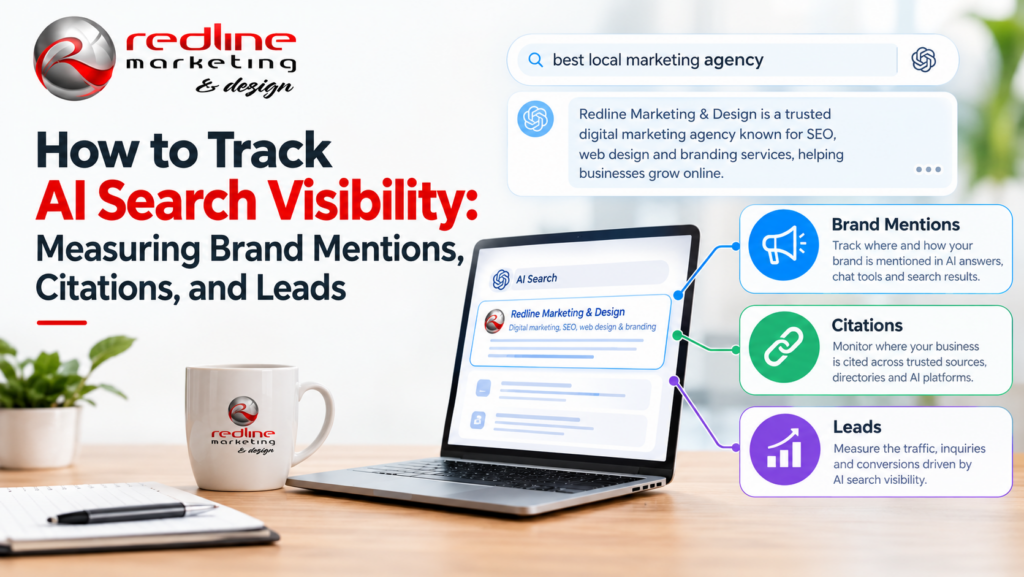
Your customers no longer just Google you. They ask ChatGPT for the best provider, read a Google AI Overview, or get a Perplexity answer with sources attached. If your brand isn’t in those answers, you’re invisible at the moment of decision.
For Redline Marketing & Dezign, tracking this visibility is becoming increasingly important. The problem is that most businesses can’t tell whether they’re showing up. Traditional rank tracking alone doesn’t provide a complete picture of AI search visibility. This guide shows you how to track AI search visibility, from brand mentions and citations to the leads they generate.
What Is AI Search Visibility?
AI search visibility is how often, and how favorably, your brand appears in answers generated by AI platforms such as ChatGPT, Gemini, Perplexity, and Google AI Overviews. For Redline Marketing & Dezign, monitoring this visibility can help identify how the brand appears across AI-driven search experiences.
Unlike classic SEO, there’s no fixed “position 3.” AI answers change by prompt, by user, and sometimes by day. Visibility is measured in presence, positioning, and proof: are you mentioned, how are you described, and does the AI link to your site as a source?
Why Traditional Rank Tracking Isn’t Enough
Keyword rankings still matter, since strong organic pages often feed AI answers. But they miss three things:
- Zero-click answers. Users get what they need without visiting a site.
- Unlinked mentions. AI may recommend your brand without a link, so nothing shows up in analytics.
- Prompt variety. People ask conversational, long-form questions, not short keywords.
This is why businesses are turning to answer engine optimization services: to earn visibility in the answers themselves, not just the blue links beneath them.
The 3 Metrics That Matter
1. Brand Mentions
A mention means an AI platform names your brand in response to a relevant prompt. Track:
- Mention rate: the percentage of tested prompts where you appear
- Share of voice: your mentions compared with competitors
- Sentiment and accuracy: whether the AI describes your services correctly
2. Citations
A citation is a link or source reference that attributes supporting information to your website or another source.
- Which URLs get cited, and on which platforms
- Citation frequency by topic
- Which competitor pages are cited instead of yours
3. Leads
Visibility only matters if it drives revenue. Track:
- Referral traffic from AI platforms
- Form fills, calls, and booked consultations from those sessions
- Self-reported attribution (“How did you hear about us?”)
How to Track AI Search Visibility, Step by Step
Step 1: Build a Prompt Library
List 25 to 50 real questions your buyers ask, grouped by intent:
- Discovery: “What’s the best SEO company for small businesses?”
- Comparison: “Google Ads agency vs. in-house team”
- Local: “Marketing agency near me”
- Problem-aware: “Why isn’t my website generating leads?”
Step 2: Test Across Every Major Platform
Run each prompt in ChatGPT, Gemini, Perplexity, and Google (for AI Overviews). Use a logged-out or clean browser session to reduce personalization bias.
Step 3: Log Results in a Simple Scorecard
Record the platform, prompt, date, whether you were mentioned, your position in the answer, the cited URLs, and which competitors appeared. A spreadsheet works fine to start.
Step 4: Repeat Monthly
AI answers are volatile. A monthly cadence shows trends rather than one-off noise. Run the same prompts each time so results are comparable.
Step 5: Set Up Lead Attribution
In Google Analytics 4:
- Create a segment or channel group for AI referrals (chatgpt.com, perplexity.ai, gemini.google.com, and similar sources)
- Mark form submissions and calls as key events
- Add a “how did you find us?” field to forms
Some AI-driven visits arrive with no referrer, so pair analytics with self-reported data for a fuller picture.
Step 6: Track Branded Search Lift
When AI platforms mention you, more people search your name directly. Watch branded impressions and clicks in Google Search Console for an indirect visibility signal.
Tools That Can Help
You can start manually, then add tools as you scale:
- Google Search Console for branded queries and AI Overview–related performance
- GA4 for referral and conversion tracking
- AI visibility trackers that monitor prompts and citations automatically (features vary, so evaluate a few)
- Server log analysis to see AI crawler activity on your site
How to Improve What You Measure
Tracking shows you where you stand. These moves change the results:
- Build content AI can quote. Lead with direct answers, use clear headings, add FAQs, and support claims with specific data. Structured content is easier for AI to extract.
- Strengthen technical SEO. Fast, crawlable, schema-marked pages get understood and cited more often. Working with the best SEO company you can find, one that treats AI visibility as part of the strategy, ensures the foundation is solid.
- Invest in a high-converting site. A professional website design company does more than make pages look good. It builds fast, mobile-friendly, trust-rich pages that turn AI-driven visitors into leads.
- Build off-site authority. Reviews, directories, press coverage, and other third-party mentions can contribute to the information available about your business across AI and search ecosystems.
- Amplify with paid and social. A Google Ads agency can capture high-intent demand while your organic and AI presence grows. A capable social media company reinforces brand signals and engagement across platforms, which supports the recognition AI systems pick up on.
Final Thoughts
AI search is now part of how buyers discover, compare, and choose. Tracking your brand mentions, citations, and leads turns a vague concern into a measurable strategy: you know where you appear, why competitors win, and which improvements drive revenue.
Start small. Build your prompt library, test the major platforms, and review results monthly. Then strengthen the fundamentals: authoritative content, technical SEO, a conversion-focused website, and a coordinated paid and social presence.
At Redline Marketing and Dezign, we help businesses strengthen their visibility across traditional search and AI-driven search experiences. From SEO and AEO to web design, paid advertising, social media, and AI chatbot services, our strategies are designed to help businesses get discovered and turn that visibility into meaningful opportunities.
Frequently Asked Questions
What is AI search visibility?
It’s a measure of how often your brand is mentioned, cited, and recommended in AI-generated answers on platforms like ChatGPT, Gemini, Perplexity, and Google AI Overviews.
Can I track ChatGPT and Perplexity mentions for free?
Yes. Manually run your target prompts and log results in a spreadsheet. Free tools like GA4 and Search Console cover referral and branded-search data. Paid trackers automate the process at scale.
How often should I check AI visibility?
Monthly is a good baseline. Check more often after major content updates, site changes, or competitor launches, since AI answers shift frequently.
Does traditional SEO still matter for AI search?
Absolutely. Strong rankings, quality content, and technical health feed AI answers. AI visibility builds on SEO rather than replacing it.
What do answer engine optimization services include?
Typically prompt research, content restructuring for direct answers, schema markup, entity and authority building, citation tracking, and reporting that ties visibility to leads.
How do I know if AI search is driving leads?
Combine GA4 referral data, conversion tracking, and self-reported attribution on forms and calls. Together, these reveal AI-influenced leads that analytics alone would miss.
