



Google Pay Per Click in 2026: How Phoenix Businesses Are Winning With AI-Driven PPC (And Why Your Website Still Decides If You Win)
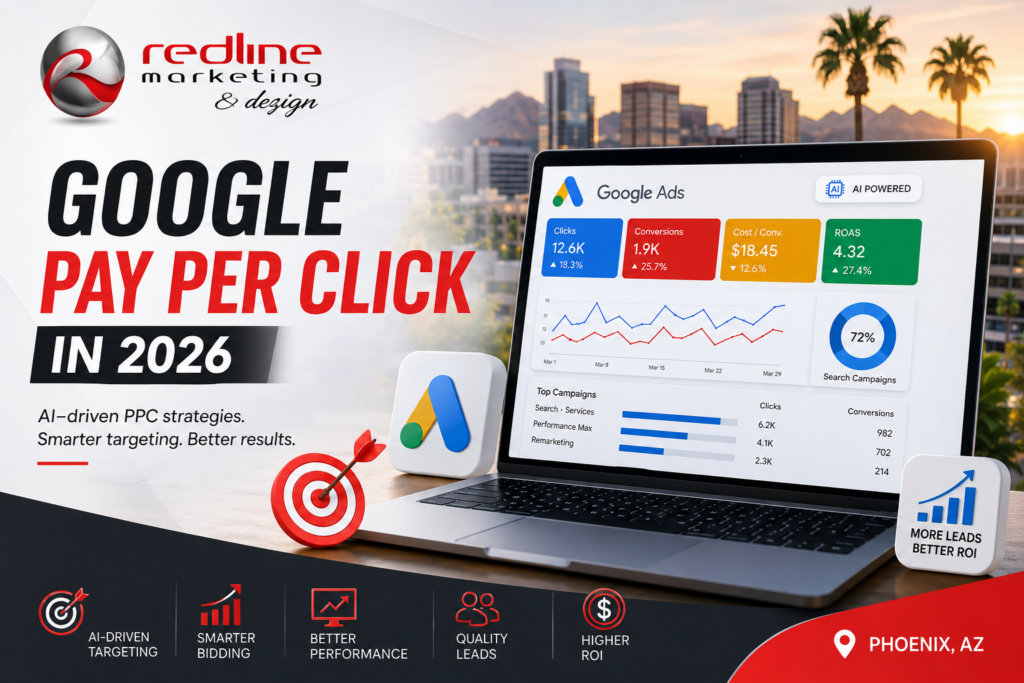
If you’ve managed a Google Pay Per Click campaign anytime in the last year, you’ve probably noticed something: the platform doesn’t feel like the one you learned on. Manual bid adjustments matter less. Performance Max keeps eating budget from other campaign types. And the “best keywords” advice from 2023 barely applies anymore.
That’s because Google Ads have fundamentally changed. And in a market like Phoenix, fast-growing, competitive, and full of businesses fighting for the same “near me” searches, understanding how it changed is the difference between wasted ad spend and a full pipeline.
Here’s what’s actually happening with Google PPC in 2026, and how Redline Marketing and Dezign builds campaigns around it for Phoenix businesses.
Google Ads Has Become an AI Co-Pilot, Not a Control Panel
The single biggest shift in Google Pay Per Click right now is automation. AI-driven bidding now handles the vast majority of decision-making inside a serious campaign, predicting conversion probability, adjusting for device, location, and time of day, and reallocating budget in real time. Manual bidding hasn’t disappeared, but it’s no longer competitive at scale for most industries.
What this means practically: the advertisers winning in Phoenix right now aren’t the ones micromanaging bids. They’re the ones who understand how to feed the algorithm the right signals, accurate conversion tracking, tight audience definitions, and strong first-party data, so Google’s AI has something good to optimize toward. Garbage signals in, garbage results out.
This is also why so many Phoenix businesses run PPC themselves for six months, spend thousands of dollars, and give up. It’s not that Google Ads stopped working. It’s that the strategy required to make it work changed, and most people are still running a 2022 playbook on a 2026 platform.
Performance Max Is Everywhere – And That’s Both an Opportunity and a Risk
Google is pushing advertisers hard toward Performance Max, a single campaign type that serves ads across Search, Display, YouTube, Discover, Gmail, and Maps using machine learning. For Phoenix service businesses, HVAC companies, med spas, law firms, home remodelers, this can be genuinely powerful, because it puts your brand in front of buyers across every surface Google owns.
The risk is brand safety and budget control. Without careful placement exclusions and asset-level review, Performance Max can spend budget on low-intent inventory. A well-run Phoenix PPC account in 2026 checks placement reports weekly, not quarterly, and treats PMax as one tool in a broader account structure, not the whole strategy.
Creative Quality Is Now a Ranking and Performance Factor
Here’s something a lot of advertisers still miss: Google now factors ad creative quality into how campaigns perform, not just relevance and bid. Scroll-stopping imagery, strong video assets, and rich media are outperforming plain text-and-stock-photo ads across Search, Shopping, and Performance Max.
This is where PPC and design stop being separate disciplines. A Phoenix HVAC company running search ads with generic stock photography is going to lose the auction, not just the click, to a competitor using sharp, localized creative. This is one of the biggest reasons Redline pairs Google Pay Per Click management with actual design talent instead of outsourcing creative as an afterthought.
First-Party Data Is the New Competitive Edge
With third-party cookies phasing out and privacy regulation tightening, the ability to feed your own customer data, email lists, CRM conversion events, phone call data, directly into Google Ads has become a real differentiator. Phoenix businesses that connect their CRM, track phone calls from ads, and pass accurate conversion values back into Google consistently outperform competitors who are still relying on default pixel tracking.
If your current PPC setup can’t tell you which specific ad, keyword, and landing page produced a paying customer, not just a form fill, you’re optimizing blind.
Why Your Landing Page Determines Whether Any of This Matters
You can run flawless Google Pay Per Click campaigns and still lose money if the page people land on doesn’t convert. This is the part most PPC-only agencies skip past, and it’s the most common reason Phoenix ad accounts underperform.
A high-converting PPC landing page needs to load fast, match the exact promise made in the ad, and make the next step (call, form, book now) obvious within seconds, especially on mobile, where most Phoenix ad traffic lands first. This is precisely where working with web designers in Phoenix Arizona who understand paid traffic, not just aesthetics, changes campaign performance. A beautiful site that takes four seconds to load will quietly bleed your ad budget no matter how good the targeting is underneath it.
PPC Doesn’t Work in Isolation Anymore
The Phoenix businesses seeing the best return right now aren’t running Google Ads as a standalone tactic. They’re pairing it with social media management Phoenix audiences already trust, so a prospect who clicks a search ad and then checks your Instagram sees an active, credible business, not a dormant page. Retargeting audiences built from social engagement are also feeding stronger, cheaper conversions back into Google Ads campaigns.
This is the real shift happening in Phoenix’s digital marketing landscape: search, social, and web design aren’t separate line items anymore. They’re one system, and treating them as disconnected vendors is a quiet tax on your ad spend.
What This Means If You’re Evaluating a Digital Marketing Agency in Phoenix
If you’re comparing a digital marketing agency for Google Ads management, ask these questions before signing anything:
- Do they build campaigns around AI-driven bidding, or are they still manually adjusting bids like it’s 2021?
- Do they review Performance Max placements weekly, or let it run unmonitored?
- Can they connect conversion data from your CRM or phone system, or only the default pixel?
- Do they design (or fix) your landing pages, or hand you off to “figure that part out”?
- Do they coordinate PPC with your social presence, or run it as an isolated service?
An agency that can’t answer all five clearly is going to leave real money on the table — yours.
How Redline Marketing and Dezign Approaches Google PPC in Phoenix
Redline Marketing and Dezign builds Google Pay Per Click campaigns for Phoenix businesses around this exact reality: AI handles the bidding, but strategy, creative, tracking, and landing page design still decide who wins. That means every PPC engagement includes:
- Conversion-focused campaign structure built for Google’s AI bidding systems
- Weekly Performance Max and placement monitoring to protect brand safety and budget
- Landing pages built (or optimized) by an in-house team of web designers in Phoenix Arizona, not outsourced
- First-party data and call tracking connected directly into your account
- Optional social media management Phoenix support to reinforce ad traffic with an active, trustworthy brand presence
Final Thoughts
Google PPC success in 2026 requires more than just running ads, it requires the right strategy, data, creative, and website experience. Businesses that combine AI-powered advertising with accurate tracking and conversion-focused landing pages are better positioned to generate quality leads and maximize their budget. As competition continues to grow in Phoenix, partnering with an experienced digital marketing team can help you stay ahead, improve campaign performance, and achieve sustainable growth. The right PPC approach turns paid advertising into a powerful tool for building long-term business success.
FAQ
How much does Google PPC management cost in Phoenix?
Costs vary based on goals, ad spend, and competition. Most businesses invest in monthly ad spend plus a management fee.
Is Google Ads still worth it in 2026?
Yes. AI improves automation, but smart strategy, tracking, and optimization still drive better results.
Why are my Google Ads clicks not converting?
Poor landing pages, unclear messaging, or weak calls-to-action often reduce conversions.
Should I use Performance Max or Search campaigns?
Both can work together, Performance Max expands reach, while Search captures high-intent customers.
How long does it take to see results from Google PPC campaigns?
Most businesses see initial data within weeks, but consistent results require ongoing optimization and testing.
Can Google PPC help small businesses compete with larger companies?
Yes. With targeted keywords, smart budgeting, and optimized campaigns, small businesses can reach qualified customers effectively.
