



Local SEO in 2026: Your Customers Are Searching. Are They Finding You?
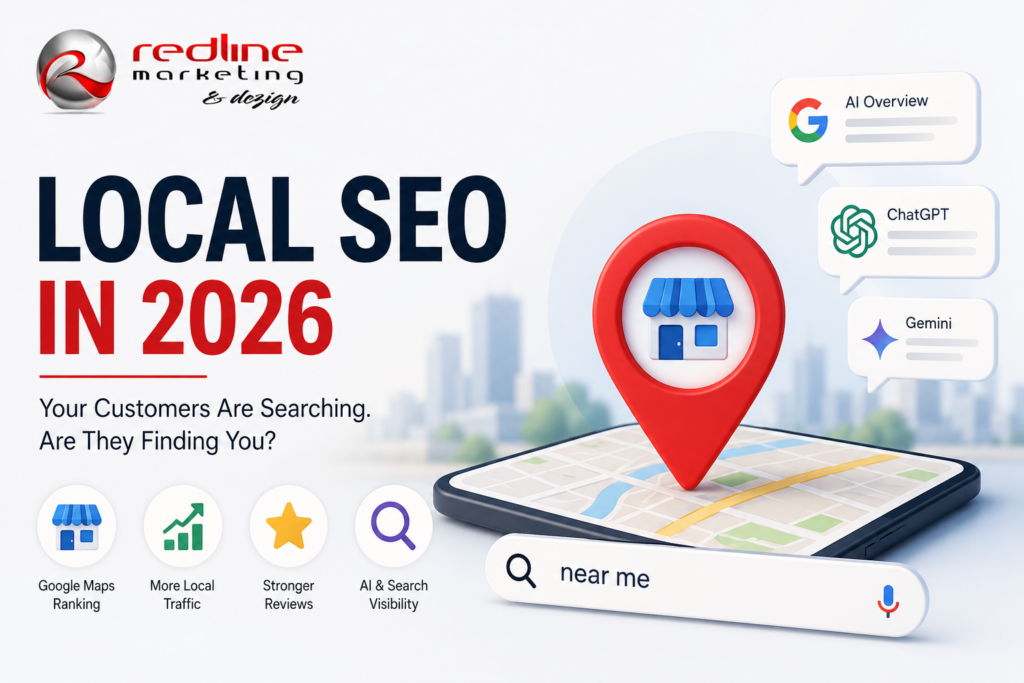
In 2026, local SEO means optimizing for Google Maps, “near me” searches, and AI-generated answers from Google AI Overviews, ChatGPT, and Gemini. Businesses winning across all three focus on an optimized Google Business Profile, consistent NAP data, fresh keyword-rich reviews, and helpful location pages. Redline Marketing & Dezign helps businesses improve their local visibility and stay ahead in today’s changing search landscape.
If you’ve ever typed “plumber near me” or “best dentist in Phoenix” into your phone, you already know how local search works from the customer’s side. What’s changed is what happens after you hit search. Google increasingly answers that question before you even see the map. So does ChatGPT, when someone asks it the same thing in a different app entirely.
For local business owners, that means the old local SEO playbook, claim your listing, get a few reviews, call it done, no longer cuts it. Here’s what actually moves the needle now.
Why Local SEO Looks Different in 2026
Search behavior has split. A large share of Google searches now end without a click because answers, business names, phone numbers, and hours are already shown on the results page. At the same time, more people are turning to ChatGPT, Perplexity, and Gemini for recommendations and comparisons. Redline Marketing & Dezign helps businesses adapt with Local SEO and AEO strategies that improve visibility across search engines and AI-powered platforms.
That creates two ranking games happening simultaneously:
- The Maps game: Can your business physically appear in the local 3-pack and Google Maps results for the searches your customers are already making?
- The AI answer game: When someone asks an AI assistant a question instead of Googling it, does your business get named as the recommendation?
Winning one doesn’t automatically win the other. But the underlying inputs, accurate business data, real reviews, and content that clearly answers questions, feed both.
The Four Pillars of Local SEO That Actually Move Rankings
1. A Fully Built-Out Google Business Profile
Your Google Business Profile (GBP) is the single highest-leverage asset in local SEO. Google uses it to decide who shows up in the map pack, and increasingly, AI Overviews pull directly from GBP data to answer local questions.
A profile that’s just “claimed” isn’t optimized. Ranking-ready profiles have:
- The correct primary category, plus every relevant secondary category
- Services or products listed with descriptions, not just names
- Weekly posts (Google treats an active profile as a trust signal)
- Q&A section seeded with real customer questions
- Photos added regularly, not just at setup
- Hours, phone number, and website that match your site exactly
2. Consistent NAP Data Across the Web
NAP stands for Name, Address, Phone number, and it needs to be identical everywhere your business is listed, your website, GBP, Yelp, Facebook, industry directories, and local citation sites. Inconsistent data (a suite number here, an old phone number there) quietly tells Google your listing might not be trustworthy, which suppresses your map ranking even if everything else is strong.
3. Reviews: Volume, Recency, and Keywords
Review count still matters, but recency and content matter more than most business owners realize. A business with 40 reviews, half of them from the last 90 days, will often outrank a competitor with 200 reviews that stopped coming in two years ago.
The content of reviews matters too. When customers naturally mention your service and city (“best HVAC repair in Chandler”) inside their review text, it reinforces the exact signals Google and AI systems use to match your business to that search. This is why review generation is no longer just a reputation task, it’s a ranking task.
4. Location Pages Built to Answer Questions, Not Just Rank
This is the piece most businesses miss entirely. A generic “Our Locations” page with an address and a map embed does nothing for AI visibility. Redline Marketing & Dezign helps businesses create location pages structured for modern search, with clear questions as headings, concise answers upfront, and supporting details that make content easier for AI Overviews and ChatGPT to understand and reference. This format works because large language models scan for content that already looks like an answer instead of traditional narrative marketing copy.
How AI Overviews and ChatGPT Choose Which Local Business to Mention
AI systems don’t rank businesses the way Google Maps does. They synthesize an answer from multiple sources, most drawn from businesses with consistent, structured information across the web, and choose which name(s) to surface based on a few consistent factors:
- Topical and geographic clarity – your content states plainly what you do and where you do it, without forcing the reader (or the AI) to infer it
- Structured, extractable content – FAQ sections, clear headings, and direct answers get pulled far more often than long-form storytelling
- Cross-platform consistency – the same business description, service list, and location details appearing on your site, GBP, and review platforms builds the kind of entity confidence AI systems rely on
- Recent signals – fresh reviews, recent posts, and updated content all suggest an active, trustworthy business
This is also why reputation management and local SEO have effectively merged into one discipline. A business with strong, recent reviews and consistent data isn’t just more trustworthy to a human reading it, it’s more likely to be the name an AI assistant recommends.
A Local SEO Checklist You Can Start This Week
- Audit your Google Business Profile for missing categories, services, and outdated hours
- Search your business name and check that your NAP data matches across your top 10 citations
- Set up a simple system to request reviews after every completed job or sale
- Rewrite one location or service page using the question-then-answer format above
- Add an FAQ section to your homepage or top service page with 4-6 real customer questions
- Check whether AI Overviews are already showing up for your top three “near me” search terms, and note who’s getting cited
Final Thoughts
Local SEO in 2026 is no longer just about ranking on Google Maps, it’s about being visible wherever customers search, whether that’s Google, AI Overviews, ChatGPT, or Gemini. Businesses that focus on accurate information, strong reviews, optimized Google Business Profiles, and helpful content will have the advantage in an increasingly AI-driven search landscape. The goal isn’t simply to rank higher; it’s to become the trusted answer customers find when they’re ready to choose a local business. With the right Local SEO and AEO strategy, Redline Marketing & Dezign helps Phoenix businesses improve visibility, build credibility, and attract more customers from both traditional and AI-powered search.
Frequently Asked Questions
What is local SEO in 2026?
Local SEO in 2026 helps businesses appear in Google Maps, near me searches, and AI platforms by optimizing profiles, reviews, local content, and online business information.
How can I improve my Google Maps ranking?
Improve Google Maps rankings by optimizing your Google Business Profile, keeping NAP details consistent, earning fresh reviews, adding photos, and updating business information regularly.
Does AI search change how businesses need to do SEO?
Yes, AI search requires clear, structured content that answers customer questions. Businesses need strong reviews, accurate data, and helpful pages to get recommended.
How long does local SEO take to show results?
Local SEO results typically take 60–90 days, depending on competition, website authority, review activity, and the level of optimization completed.
Why are customer reviews important for local SEO?
Customer reviews build trust with search engines and users. Recent, detailed reviews with relevant services and locations can improve local rankings and AI visibility.
Do I need separate strategies for Google Maps and AI search?
No, a strong local SEO strategy supports both. Optimized profiles, quality content, reviews, and consistent business data improve visibility across search platforms.
