



Why Your Business Needs to Show Up in ChatGPT and Google AI Overviews in 2026 (Not Just Google)
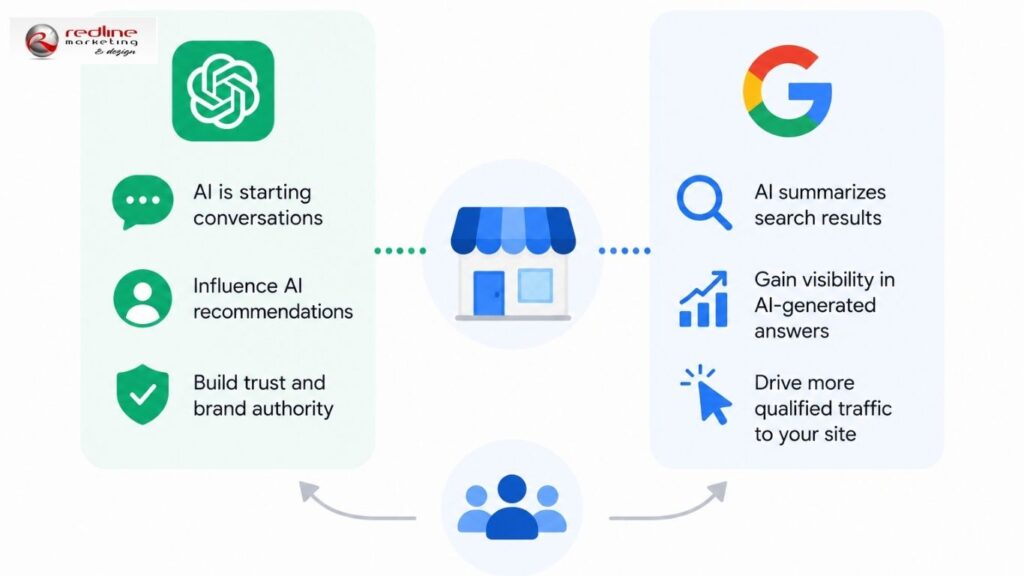
Here’s something most business owners don’t realize yet: your customers aren’t just Googling you anymore. They’re asking ChatGPT, Gemini, and Perplexity questions like “who’s the best digital marketing agency near me” or “which company should I hire for SEO in Phoenix“, and getting a direct answer, with zero clicks to any website.
If your business isn’t mentioned in that answer, you don’t exist to that customer. It doesn’t matter how great your service is. This is the single biggest shift in how people find businesses since Google itself became a verb, and in 2026, it’s no longer optional to understand it.
This guide breaks down exactly what’s changing, why it matters for your bottom line, and what you can actually do about it, whether you handle it yourself or bring in a team like ours.
What Is AI Search Visibility (AEO), and Why Should You Care?
AEO stands for Answer Engine Optimization. Think of it as the evolution of SEO. Traditional SEO gets your website ranked on a results page. AEO gets your business quoted, cited, or recommended directly inside an AI-generated answer, on ChatGPT, Gemini, Perplexity, or Google’s AI Overviews.
The numbers back up why this matters right now. AI Overviews are already showing up on a large share of Google searches, and that share climbs even higher for specific, long-tail questions, the exact kind of searches your customers use when they’re ready to buy, not just browsing. Meanwhile, a large majority of businesses report they’re worried about staying findable in this new AI-driven landscape, and most are already increasing their budgets to deal with it.
In plain terms: the businesses that adapt now will dominate the next five years of search. The ones that don’t will quietly disappear from customer consideration, without ever knowing why their phone stopped ringing.
How AI Search Actually Works
Old-school SEO was about keywords and backlinks. AI search engines work differently. They read your website, your Google Business Profile, your reviews, and other trusted sources across the web, then piece together an answer based on how clearly organized and trustworthy that information is.
A few things AI systems specifically look for:
Clear, direct answers near the top of your pages, not buried three paragraphs down Consistent business information everywhere it appears online (name, address, phone number, services) Genuine expertise and real detail, not generic filler content Up-to-date content, since AI tends to trust and cite pages that are recently refreshed Structured data (schema markup) that helps AI understand exactly what your business does and where
If your website content is vague, outdated, or inconsistent with your Google Business Profile, AI systems either skip you entirely or, worse, pull incorrect information about your business from somewhere else on the internet.
Why This Directly Affects Your Revenue
Here’s the part that should get your attention: when a business does get named inside an AI answer, the customer reaching out tends to be far more ready to buy. They’ve already had their questions answered. They already trust the recommendation. They’re calling to book, not to “just get more info.”
That means AI visibility isn’t just a traffic play, it’s a conversion play. Fewer, but much higher-intent leads landing in your inbox and on your phone.
On the flip side, businesses that get left out of AI answers are losing those same high-intent customers to competitors, quietly, with no warning sign on their analytics dashboard. Your click volume might even look fine while your best leads disappear somewhere upstream.
5 Things You Can Do Right Now to Improve Your AI Search Visibility
- Update your Google Business Profile. This is one of the strongest data sources AI tools pull from. Make sure your hours, services, categories, and photos are current.
- Add clear, direct answers to your website. If people ask “how much does X cost” or “how long does X take,” answer it plainly near the top of the relevant page, not hidden in a paragraph.
- Keep your business information consistent everywhere. Your name, address, and phone number should match exactly across your website, directories, and social profiles. Inconsistency confuses AI systems and hurts trust.
- Collect and respond to reviews consistently. AI systems weigh review volume and recency heavily when deciding which businesses to recommend.
- Refresh your content regularly. Stale pages lose citations to competitors who keep their information current. A quarterly content review goes a long way.
Where a Lot of Businesses Get Stuck
Most business owners we talk to know something has changed, but they don’t have the time, tools, or technical background to fix it themselves. That’s usually where the visible symptoms show up: rankings that used to work stop converting, ad spend stretches further without better results, and reviews sit unmanaged while competitors pull ahead.
This is exactly why we built AEO into how we approach every client’s strategy at Redline Marketing & Dezign, alongside the SEO, Google Ads, reputation management, and web design work we’ve always done. It’s not a separate add-on service, it’s baked into the process from day one.
How Redline Marketing & Dezign Can Help
We start every client relationship with a free reputation and visibility audit, so you know exactly where you stand, on Google, in AI search results, and everywhere in between, before you spend a dollar with us. From there, we build a custom strategy using the right mix of SEO, AEO, Google Ads, social media, reputation management, and web design for your specific business and budget. If you’re a Phoenix-area business owner wondering whether your competitors are already showing up in ChatGPT or AI Overviews and you’re not, that’s exactly the kind of question we answer on our free strategy calls, no pressure, no jargon, just a clear picture of where you stand and what it would take to fix it.
Conclusion
Search isn’t disappearing, it’s just splitting into two lanes: traditional organic rankings and AI-generated answers. Businesses that show up in both will capture more visibility and more high-intent customers than ever before. Businesses that ignore the second lane will find themselves competing for a shrinking slice of attention, without understanding why. The good news is that most of the groundwork, clear content, consistent business information, strong reviews, and a well-structured website, benefits both traditional SEO and AI search visibility at the same time. You don’t need two separate strategies. You need one strategy built correctly from the start. If you’re ready to find out exactly where your business stands in both Google rankings and AI search results, book a free strategy call with Redline Marketing & Dezign. We’ll show you precisely what’s working, what’s not, and what it would take to make sure your business is the one AI recommends.
Frequently Asked Questions
What is the difference between SEO and AEO?
SEO helps your website rank in traditional search results to earn clicks. AEO focuses on getting your business cited directly in AI answers like ChatGPT or Google AI Overviews.
How long does it take to see results from AEO?
You may see early AEO signals within a few weeks if your SEO is strong. Full, stable AI visibility usually takes 2–3 months of consistent optimization and content improvements.
Do I need a separate AI search strategy, or does SEO cover it?
SEO is the foundation, but AEO needs added work like structured data, clear answers, and consistent business info. Most businesses adapt existing SEO rather than starting from scratch.
Is Google Business Profile still important if AI search is growing?
Yes, it’s critical. AI tools often pull local data from Google Business Profile, making it a key source for visibility in both search and AI-generated recommendations.
Will AI search visibility bring more customers or just traffic?
AI search usually brings higher-intent customers. Users get answers before clicking, so the traffic is smaller but often converts better due to stronger purchase intent.
How do I know if my business shows up in AI search results?
Test prompts in ChatGPT, Gemini, or Perplexity using customer-style questions. A full audit reviews your listings, schema, content, and consistency across all platforms.
